

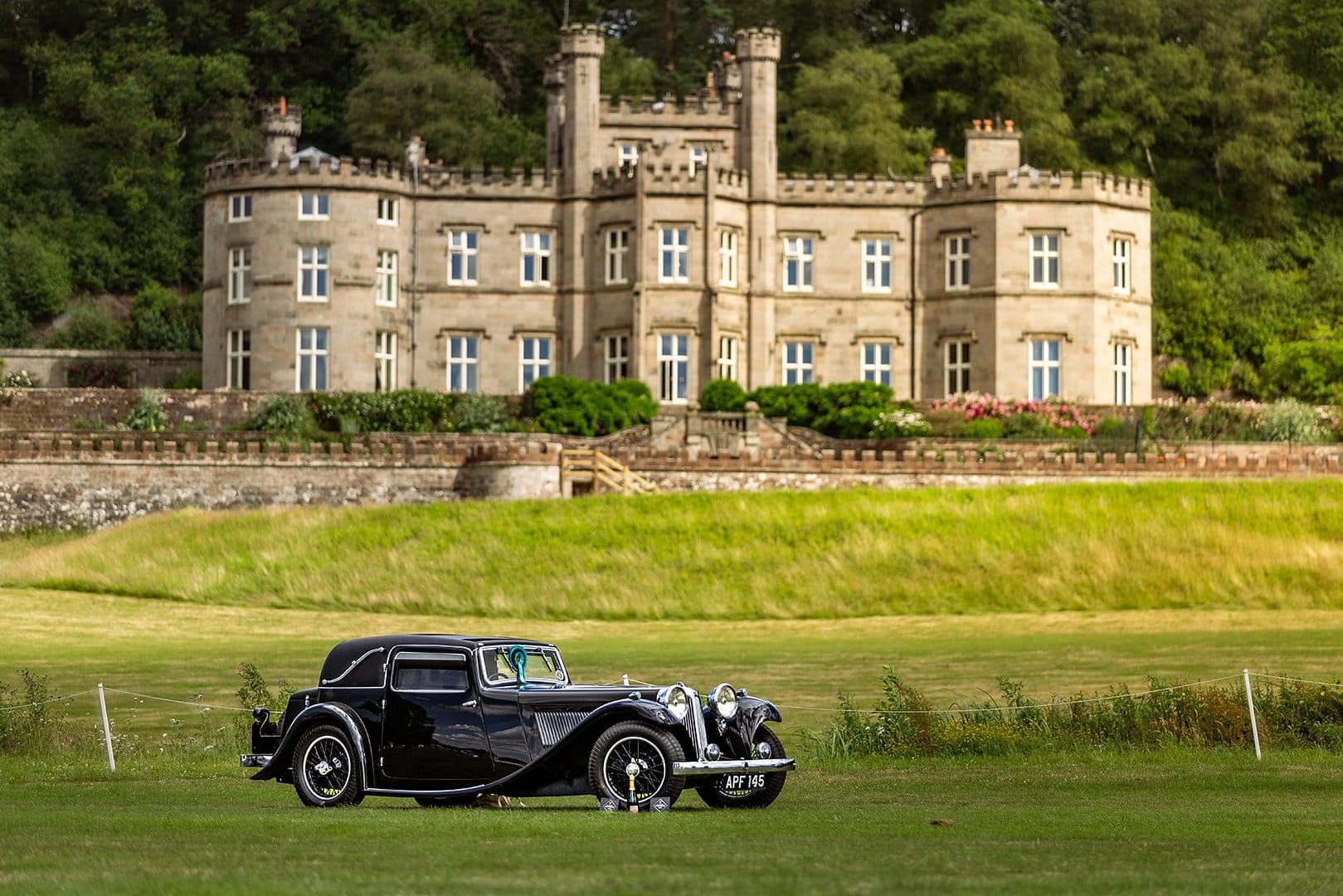
Bolesworth Concours 2026 Entrants
Register Your Interest for 2027
The British Sporting Icons
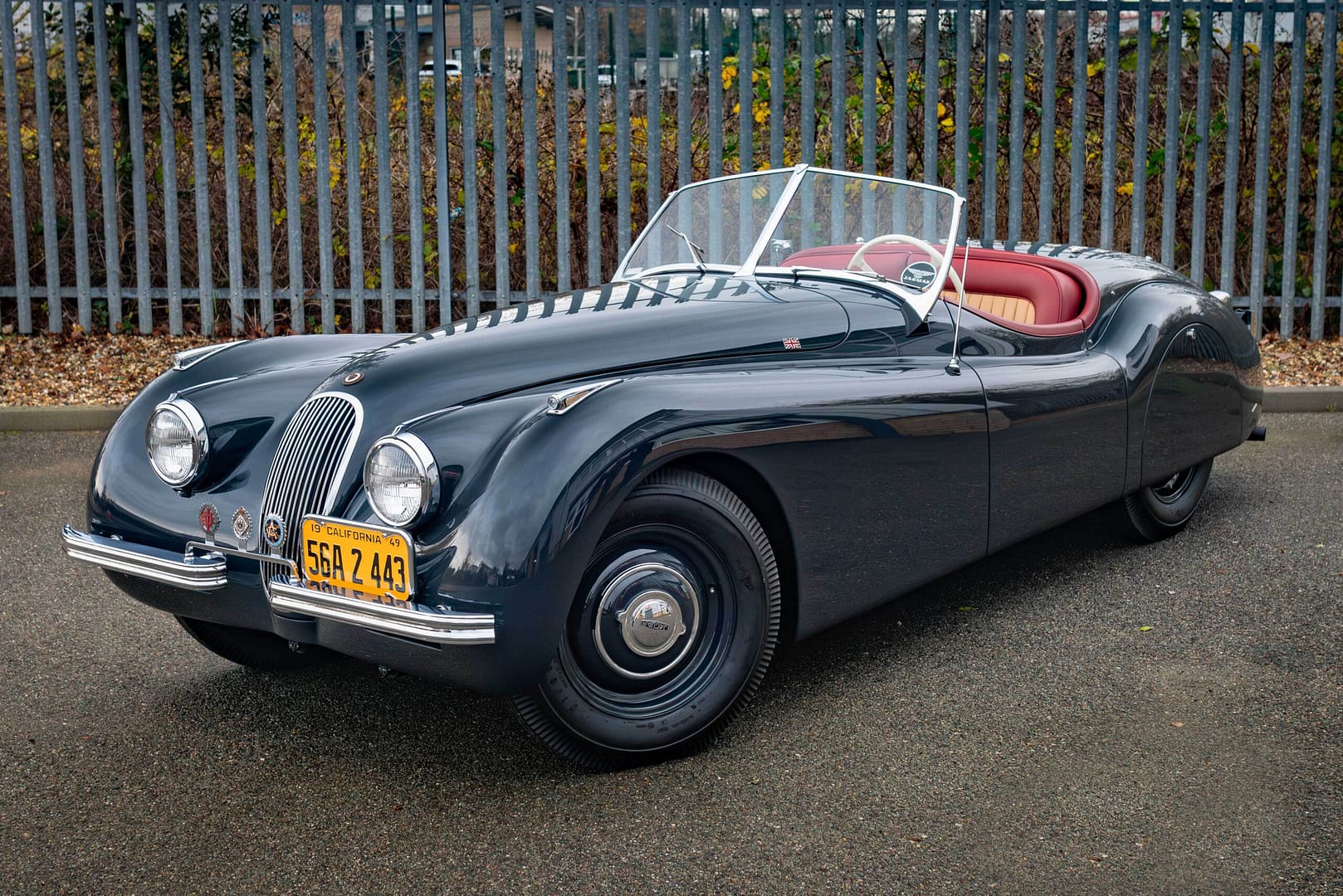
1949 Jaguar XK 120
Few British sports cars have enjoyed the impact and enduring appeal of the Jaguar XK120. Introduced in 1948, its sleek lines and advanced twin-cam engine made it the fastest production car in the world and established Jaguar as a force to be reckoned with on the international stage.
Chassis 670003 holds a particularly special place in the model’s history. The third XK120 built, it was the first example sold to a customer and the first to be imported into the United States. Supplied through International Motors of Hollywood, it became the property of screen legend Clark Gable, who had the car refinished in the distinctive “Gable Grey” it wears today. Road & Track famously featured Gable with the car in 1950, recording a remarkable 124 mph from the standard aluminium-bodied roadster.
One of just 240 hand-built aluminium XK120s produced, this extraordinary Jaguar underwent a no-expense-spared restoration before being awarded Best in Class at the Pebble Beach Concours d’Elegance in 2012, confirming its status as one of the most important XK120s in existence.
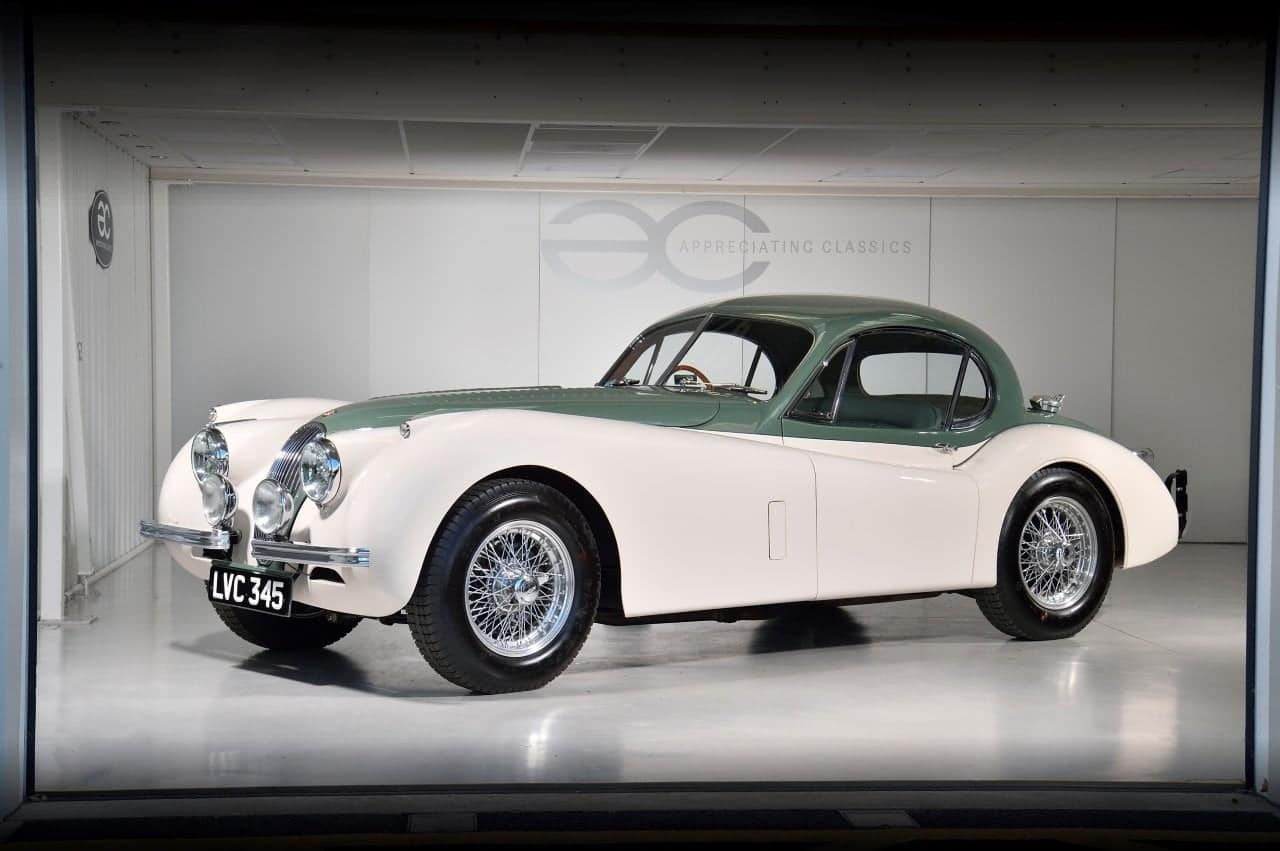
1952 Jaguar XK 120
Few historic Jaguars can boast a provenance as remarkable as that of LVC 345. A Jaguar Works car supplied by Sir William Lyons to Sir Stirling Moss in 1952, this XK120 Fixed Head Coupé was finished in a distinctive colour scheme personally chosen by Moss, making it uniquely associated with Britain’s greatest racing driver.
Initially provided as a loan car before becoming Moss’s own, LVC 345 accompanied him across Europe as he travelled between race meetings, covering thousands of miles and even towing a caravan on occasion. The car also competed in the demanding 1952 Rallye des Alpes Françaises, demonstrating the performance and durability that helped establish the XK120’s reputation.
Sold by Moss upon joining Mercedes-Benz in 1954, the car passed to Raymond Playford, founder of the Jaguar Drivers’ Club. Today, LVC 345 stands as one of the most celebrated surviving XK120s, embodying the elegance, performance and sporting spirit that defined Jaguar’s golden era.
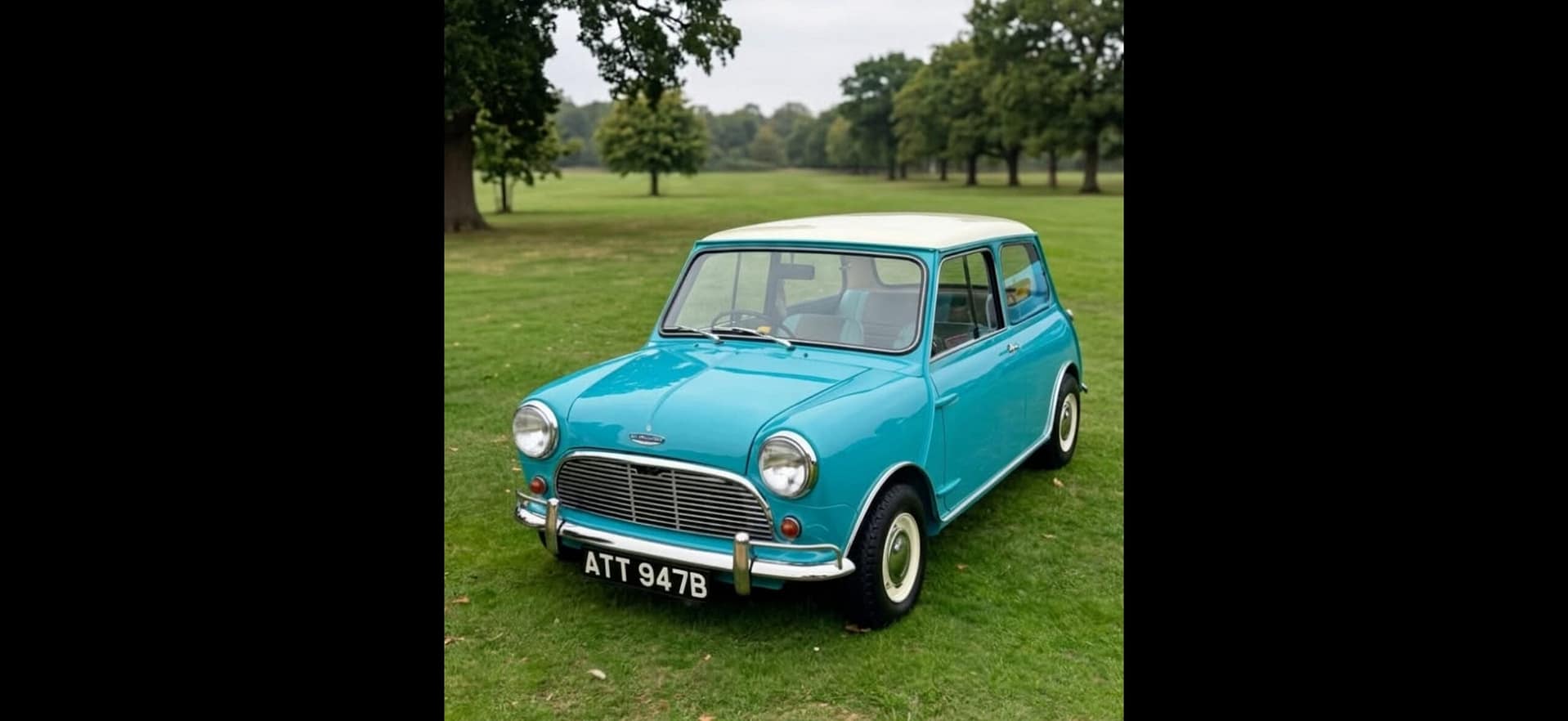
1964 Austin Cooper S MK1
A matching numbers Austin Cooper S. First registered 26th June 1964 to A.C Bulpin & Son LTD, Devon. Only 2 owners to date and still with its original shell. Originally acquired approximately 6 year ago, it had been painted brown around the bottom and gold around the top! It was very like Steve McQueen’s mini but with a little rust.
The 1275 mk 1 cooper S was first produced in March 1964. So this is an early ‘dry’ car. They were only produced for a few months before hydrolastic suspension was introduced in September 1964. Now in its original colour of rare surf blue with old English white roof. The original owner ticked the options of an air heater, 4.5” wheels and an oil cooler, all of which it still retains. This is a single tank car, as contrary to popular believe, twin tanks were not standard on the S until January 1966. Original front subframe, front hubs, calipers and driveshaft that were all refurbed. It has the original rods, crank and block, gearbox and gears and baulk rings. Everything you are seeing on the car, is to original specification.
Once completed in spring 2025, the car was enjoyed and entered the main showcase event for the British Mini Club at Stanford Hall in September, sponsored by Maguires. The car won concours and in doing so went on to represent The British Mini Club at the Maguires club showcase competition at the NEC in November 2025.

1965 Jaguar E- Type
Widely regarded as one of the most beautiful cars ever created, the Jaguar E-Type combined breathtaking performance with timeless styling and helped cement Britain’s reputation for producing world-class sports cars. The introduction of the 4.2-litre engine in 1964 brought increased torque and refinement, further enhancing the model’s grand touring credentials.
This exceptional two-owner example has covered just 61,000 miles from new and has been painstakingly conserved rather than restored. Acquired during the Covid lockdown, the car underwent a sympathetic programme of preservation aimed at retaining as much originality as possible. Its largely original body panels were carefully repaired rather than replaced, while specialists from The Leather Conservation Company undertook the unusual task of preserving the original interior trim, maintaining both its appearance and functionality.
Mechanically rebuilt using as many original components as possible, this remarkable E-Type retains the character, authenticity and soul that make truly unrestored examples so highly prized today.

1973 Jaguar E Type
The final evolution of Jaguar’s E-Type, the V12 Roadster combined the model’s timeless beauty with effortless performance and refinement. Finished in elegant Opalescent Silver Blue, this example has enjoyed a remarkable history, spending almost five decades in the care of its first owner, a Californian dentist who purchased the car new in September 1973 and cherished it for 48 years.
Having spent its entire life in the dry climate of Southern California, the car retained all of its original body panels when it returned to Britain in 2021. A painstaking nut-and-bolt restoration followed, documented by over 2,000 photographs and undertaken with the aim of creating a car that remained true to Jaguar’s vision while enhancing its usability. Retaining its matching numbers and accompanied by comprehensive records dating back to its original purchase, this beautifully restored Roadster stands as a fitting tribute to the enduring appeal of the E-Type, more than half a century after its debut.
The Coachbuilt Masters

1933 Standard Swallow
Built on 13th February 1933 by the Standard Swallow Coachbuilding Company in Coventry, this elegant SS1 represents the formative years of what would later become Jaguar, when William Lyons’ ambition was already reshaping the idea of accessible sporting luxury. Supplied new through Henley’s Limited of London to Mr E.M. Bowden of EC4, the car quickly found a life of careful stewardship rather than heavy use.
In 1937 it passed to Miss Betty Foley of Portsmouth, a relative of the current custodian, who used the SS1 regularly until 1963 before preserving it in storage for a further decade. Acquired in 1973 and subsequently dry-stored for nearly thirty years, the car underwent an exhaustive eight-year restoration with Wildae Restorations, completed in 2009. Since then, it has achieved notable concours success, including multiple trophies at the 2015 Concours of Elegance at the Palace of Holyroodhouse, earning an invitation to Windsor Castle in 2016.

1938 Talbot-Darracq T3
Few pre-war automobiles capture the imagination quite like this Talbot-Darracq T23, a remarkable synthesis of advanced French engineering and the flamboyant artistry of Figoni et Falaschi. Built on the short-wheelbase Talbot-Lago chassis from Suresnes, its sweeping, aerodynamic form embodies the most expressive period of continental coachbuilding, when beauty and speed were conceived as one.
At its heart lies Walter Becchia’s 4-litre six-cylinder OHV engine, a design whose engineering excellence would later underpin Talbot-Lago’s celebrated competition programme, including major successes at the 1937 French Grand Prix and the 1938 Tourist Trophy. Road test figures from The Motor in 1939 confirmed its effortless performance and exceptional road manners, with a top speed exceeding 100 mph in grand touring comfort.
With fewer than 27,000 miles recorded and an ownership history that spans Europe and America—including Pebble Beach concours judge Craig Douglas—this T23 survives as an exceptionally original and highly regarded example of pre-war French design at its most expressive and accomplished

1939 Bentley Mark V Corniche
The Corniche stands as one of the most fascinating “what if” stories in Bentley history—a design born at the intersection of pre-war aerodynamic ambition and post-war reverence for lost innovation. Inspired by the radical 1938 “Embiricos” Bentley, itself a landmark in streamlined coachbuilding by Georges Paulin and Pourtout, the Corniche was conceived as a fast, flowing interpretation of the forthcoming Mark V, developed in collaboration with Carrosserie Vanvooren in Paris.
A prototype reached over 109 mph at Brooklands in 1939, confirming its performance potential, but tragedy and history intervened. A crash during testing and the outbreak of war led to the destruction of the original body, leaving the Corniche as an unfinished chapter—yet one that would later influence the R Type Continental, arguably Bentley’s most iconic post-war grand tourer.
Recreated in 2019 by Bentley Mulliner for the marque’s centenary, this example combines original Mark V mechanical components with meticulous coachbuilding to match the lost design in full detail. Finished in Imperial Maroon with Heather Grey accents, it is both tribute and resurrection—a bridge between pre-war experimentation and Bentley’s enduring grand touring philosophy.

2004 Aston Martin
The DB7 Zagato represents one of the final and most exclusive collaborations between Aston Martin and the legendary Milanese coachbuilder, reinterpreting the DB7 Vantage through Zagato’s distinctive design language of compact proportions and muscular elegance. This example—numbered 098/099 and understood to be the last right-hand-drive car produced—occupies a particularly significant place within the limited series.
Beneath its bespoke Aston Martin Green bodywork lies an uprated 6.0-litre V12 producing 435 bhp, paired with a 6-speed manual gearbox and a revised 4.09:1 final drive for sharper acceleration. Enhanced suspension and braking systems, featuring double aluminium wishbones and bespoke dampers, were developed to deliver a more focused, driver-led character.
The interior is trimmed in Chestnut leather with matching suede headlining and walnut veneer, complemented by Becker navigation and period accessories. Accompanied by its original bespoke equipment—including numbered luggage covers, a factory leather jacket, and tailored car cover—this DB7 Zagato stands as a highly specified and exceptionally well-preserved example of modern-era coachbuilt exclusivity.

1967 Lamborghini 400 GT
Introduced as the successor to Ferruccio Lamborghini’s original 350 GT, the 400 GT combined refined grand touring performance with the elegant coachbuilt lines crafted by Carrozzeria Touring of Milan. Employing Touring’s celebrated Superleggera construction technique, which used lightweight alloy panels over a tubular framework, the model stands among the finest expressions of Italian automotive artistry of the 1960s.
Finished in its original Grigio St Vincent, this particularly distinguished example was purchased by acclaimed filmmaker Sir David Lean as a wedding gift for a fellow director. Remarkably, it retains not only its factory colour scheme but also its unique and original tobacco-coloured pigskin interior, a highly unusual specification and a testament to the car’s exceptional originality. Rich in provenance and craftsmanship, it represents a rare survivor from Lamborghini’s formative years.

1949 Bently Mark V1 coupé
[Picture for reference only, this is not the actual car]
Among the most elegant post-war Bentleys, the Mark VI provided a canvas for Britain’s finest coachbuilders, with Freestone & Webb creating some of the most distinctive and exclusive bodies of the period. Affectionately known as “Cleo”, this beautifully proportioned coupé is one of just two examples constructed to this exact specification, making it an exceptionally rare survivor.
Finished in Blue Metallic over burgundy leather, the car embodies the craftsmanship and understated luxury synonymous with the great British coachbuilding tradition. Remarkably advanced for its day, it was equipped with electrically operated windows, a feature rarely encountered on cars of the late 1940s. Combining rarity, elegance and technical sophistication, “Cleo” stands as a wonderful example of bespoke motoring from the golden age of coachbuilt Bentley motor cars.
The Italian Thoroughbreds

1968 Lamborghini Miura S
Originally delivered in 1968 as a Miura P400 finished in white, this remarkable example quickly entered a more storied chapter of its life when, at just one year old, it was part-exchanged into the garage of Bernie Ecclestone. It was during his ownership that the car was returned to Sant’Agata for factory upgrade to full “S” specification and refinished in striking Candy Apple Green, elevating both its performance and presence.
Following its transformation, the Miura was sold to Justin de Villeneuve, manager of supermodel Twiggy, and has since been affectionately known in the UK as the “Twiggy Miura”. This association adds a distinct cultural layer to an already significant mechanical icon.
Retained within the current family ownership since 2000, it remains a cherished and highly individual example of Lamborghini’s defining mid-engined masterpiece, combining factory evolution, celebrity provenance, and enduring desirability.

1988 Lamborghini Countach QV
Few cars have captured the imagination quite like the Lamborghini Countach. Penned by Marcello Gandini and first unveiled in 1971, its dramatic wedge-shaped silhouette and scissor doors redefined the supercar and established a design language that continues to influence exotic cars to this day.
Introduced in 1985, the Quattrovalvole (“four-valve”) represented the ultimate evolution of the original Countach. This particular example belongs to the highly desirable “1988½” series, a transitional specification introduced midway through the model year and prized by enthusiasts for its distinctive blend of styling and mechanical refinements.
Finished in timeless black, the car perfectly embodies the theatre and ambition that made the Countach the definitive poster car of the 1980s. More than half a century after its debut, Gandini’s masterpiece remains one of the most instantly recognisable and influential supercars ever created.

2002 Ferrari 575 Prototype
This exceptional 575 Maranello occupies a uniquely significant position in Ferrari’s modern V12 lineage as one of only two official pre-production prototypes used by the factory during the launch programme. As the very first 575 chassis constructed, it effectively represents the birth of Ferrari’s front-engined V12 model equipped with the then-new F1-style automated manual transmission.
Finished in Rosso Corsa 322 and fitted with Scuderia wing shields, the car was retained by Ferrari for press and marketing use before being officially registered in 2006 and released from the factory collection in 2008. Its early life was therefore entirely within Ferrari’s control, ensuring it served as a reference point for development, presentation, and global media introduction.
Following its factory custodianship, the car was sold directly to a VIP Italian client, at which point it was fully recommissioned, including a colour change, retrim in Pelle Beige VM4028 leather, and mechanical updates. With just over 12,000 kilometres recorded, it remains a rare insight into Ferrari’s internal development process at the turn of the century, bridging prototype engineering and customer delivery in a single, significant example.

2004 Ferrari 575 HGTC
The HGTC specification represents the ultimate evolution of the 575M Maranello, developed as a factory performance package to sharpen the grand touring character of Ferrari’s front-engined V12 flagship. This example, finished in classic Rosso Corsa over Nero leather, presents the model in its purest and most desirable factory configuration.
The HGTC package—short for Handling Gran Turismo Competizione—transformed the 575’s dynamics through a comprehensive suite of upgrades, including stiffer springs, revised dampers, lowered ride height, and uprated anti-roll bars. Performance is further enhanced by a 19-inch wheel set, Enzo-derived carbon ceramic braking system, revised gearbox software, and a freer-flowing exhaust system, all working together to deliver a more immediate and engaging driving experience without compromising long-distance capability.
The result is a V12 grand tourer with heightened precision and presence, retaining the elegance of the original 575M while introducing a more focused, competition-inspired edge. In this specification, it stands as one of the most complete expressions of Ferrari’s early-2000s engineering philosophy.

1975 Ferrari 365 GT4 Berlinetta Boxer
The 365 GT4 BB marks a pivotal moment in Ferrari’s history as the brand’s first mid-engined road car to feature the now-iconic flat-12 configuration, and one of the earliest road-going Ferraris to prominently display the Prancing Horse emblem in its design language. Introduced in the mid-1970s, it set the template for Ferrari’s Berlinetta Boxer lineage that would define the marque’s flagship direction for over a decade.
This example, finished in Rosso Bordeaux over Nero Daytona seats with contrasting Rosso carpets, was delivered new on 28th May 1975 and forms part of the limited production run of just 387 cars, of which only 88 were right-hand drive and 58 allocated to the UK market. It was one of those cars personally imported by Colonel Ron Hoare, a key figure in Ferrari’s UK history.
With a long and well-documented history dating back to 1977, including a feature appearance on the cover of Autocar reportedly driven by James Hunt, the car has spent much of its recent life in long-term dry storage before undergoing a careful and extensive recommissioning. Today, it stands as a rare and authentic survivor of Ferrari’s bold transition into the mid-engined supercar era.

1968 Lamborghini Islero
A quietly rare and often overlooked grand tourer, the Islero represents Lamborghini’s most restrained expression of its front-engined V12 philosophy, with just 127 examples built in total. Intended as the successor to the 400 GT, it retained the marque’s mechanical sophistication while adopting a more understated, steel-bodied design aimed at a discerning clientele who favoured discretion over spectacle.
This example was first delivered to Switzerland, where period regulations banning spinner-style wheel caps resulted in its distinctive specification without knock-off spinners and fitted with the rare two-spoke steering wheel, further distinguishing it from standard production cars.
The subject of a full nut-and-bolt restoration completed in 2024, the car has since enjoyed a highly successful concours career, receiving awards at Salon Privé, Blenheim Palace, Yorkshire Elegance, and the London Concours. Today, it stands as an exceptionally well-presented and historically interesting survivor of Lamborghini’s early grand touring era.
The Racing Legends

1939 Lagonda Le Mans Special
This exceptional Lagonda Le Mans Special is rooted directly in the marque’s 1939 Le Mans programme, built on one of five short chassis originally reserved for endurance competition. Of these, two were developed and raced at Le Mans, achieving remarkable results with third and fourth place finishes in the 24 Hours, establishing Lagonda as a serious pre-war sporting force.
Originally constructed as a tourer, the car’s life was dramatically reshaped after a post-war accident in 1945, when it returned to the factory and was rebuilt as a Le Mans rolling chassis using one of the remaining unused 1939 competition chassis. It retained the same V12 engine, running gear, suspension and core mechanical architecture as its racing siblings, effectively preserving the DNA of Lagonda’s most ambitious pre-war project.
Over the past two decades, the car has been carefully evolved and refined by Dennis Pilling & Son, combining original mechanical components with meticulous coachbuilding to create a sleeker, lower and more capable interpretation of the original Le Mans specification. Notably, it has also served in prominent ceremonial use, including a drive along the Long Walk into Windsor Castle for the 2016 Concours of Elegance—an appropriately regal chapter for one of Lagonda’s most significant surviving competition-derived automobiles.

1955 Lotus VIII
Chassis TYC 700 occupies a uniquely important place in Lotus history as one of just seven Mk VIII cars built, and the first production example of Colin Chapman’s revolutionary streamlined sports-racing design. Developed in collaboration with aerodynamicist Frank Costin, the Mk VIII marked Lotus’s transition from lightweight specials to scientifically engineered competition cars, combining aviation-derived thinking with Chapman’s uncompromising pursuit of efficiency.
At its core lies a 1486cc MG XPAG engine, housed within an exceptionally light 35lb spaceframe chassis designed by aeronautical engineers Peter Ross and Gilbert McIntosh. With a total weight of just 521kg, the car was capable of exceeding 120 mph, delivering performance that belied its modest displacement. It also introduced advanced engineering features for its time, including a flat-floor aerodynamic body by Williams & Pritchard, de Dion rear suspension, and magnesium Alfin drum brakes.
Famously raced and road-used by early custodians—including T.G. Cunane, who preferred it over his Jaguar XK140—TYC 700 retains its original aluminium body and spaceframe, making it widely regarded as the most original surviving Mk VIII. Carefully restored in the 1990s after decades of careful preservation, it stands today as a remarkably complete and authentic expression of Lotus’s formative competition philosophy.

1962 Austin Healey 3000 Mk II 'Works'
Few British sports cars are as closely associated with competition success as the Austin-Healey 3000. Renowned for its blend of performance, reliability and long-distance touring ability, the model became a formidable force in international rallying and endurance events, with factory-backed “Works” cars achieving notable successes throughout Europe.
Finished in the iconic red and white colour combination synonymous with the marque’s competition exploits, this 3000 Mk II captures the spirit of the golden age of British sports cars. Combining rugged mechanical simplicity with elegant styling and an unmistakable six-cylinder soundtrack, it remains one of the most charismatic and celebrated sporting machines of its era, embodying the adventurous spirit that made the Austin-Healey name famous around the world.

2025 FIA C-Type Race Car
This meticulously executed FIA C-Type Race Car is a faithful continuation of one of motorsport’s most defining designs, recreating the spirit and engineering purity of the original Jaguar XK120C that transformed endurance racing in the early 1950s. While not an original factory-built example, it has been constructed to exacting historic specification standards and is in the process of obtaining an FIA Historic Technical Passport, confirming its eligibility for international historic competition.
The original C-Type, developed under Jaguar’s chief engineer William Heynes and shaped by aerodynamicist Malcolm Sayer, was conceived specifically for endurance racing. Its triangulated lightweight tubular chassis and aviation-inspired aluminium bodywork delivered a breakthrough combination of strength, efficiency, and aerodynamic clarity. This philosophy culminated in one of the most significant debuts in motorsport history, when the C-Type won the 1951 24 Hours of Le Mans on its first attempt, with Stirling Moss setting a new lap record and Peter Walker and Peter Whitehead securing outright victory.
Bentley Through The Ages

1927 Bentley 6 1/2 litre Doctors coupe – body by Harrison
Originally delivered in 1927 as a Harrison-bodied saloon, this remarkable 6½ Litre Bentley has lived an extraordinary life over the past century. Today, it wears a unique and original two-door Doctor’s Coupé body by Harrison, making it a truly one-of-a-kind motor car.
The vision behind its restoration was simple yet ambitious: to create a “Big Bentley” that combined beauty with purpose, drawing inspiration from the marque’s Le Mans heritage and creating the kind of machine the Bentley Boys themselves would have relished driving across Europe to the race tracks. Under the guidance of renowned Bentley specialist David Ayre and a team of master craftsmen, no compromise was accepted in the pursuit of authenticity and engineering excellence.
Fast, comfortable and entirely unrepeatable, YF 2186 stands today as a fitting celebration of the spirit and enduring legacy of the great W.O. Bentleys.

1936 Bentley Vanden Plas 4 Door 'Derby'
Introduced in 1936, the Bentley 4¼ Litre represented the pinnacle of British luxury motoring between the wars. Built in Derby and widely regarded as the most sophisticated car money could buy during the 1930s, it combined effortless performance with engineering refinement that set new standards for the era.
The larger 4¼-litre engine brought increased power and flexibility, complemented by advanced features including a synchromesh four-speed gearbox, servo-assisted brakes, adjustable rear suspension and twin SU carburettors. Clothed in elegant four-door coachwork by Vanden Plas, this Derby Bentley embodies the understated style and craftsmanship that attracted royalty, racing drivers and notable figures alike. Nearly ninety years after its introduction, it remains a quintessential expression of W.O. Bentley’s philosophy of creating “a fast car, a good car, the best in its class.

1961 Bentley S2 Drophead Coupe
Introduced in 1959, the Bentley S2 was among the most refined and technologically advanced luxury cars of its day. Beneath its elegant lines lay Bentley’s all-new lightweight aluminium V8, an engine whose remarkable design would evolve to power the marque’s flagship models for more than six decades.
Among the rarest expressions of the S2 was the Drophead Coupé by H.J. Mulliner, with just fifteen examples produced. Combining traditional coachbuilt craftsmanship with effortless grand touring ability, the model represented the pinnacle of Bentley motoring in the early 1960s. Finished in period-correct Ming Blue with a Fawn interior, this beautifully restored example celebrates both the enduring legacy of Bentley’s legendary L-Series V8 and the artistry of one of Britain’s finest coachbuilders.

1993 Bentley Turbo R
Widely regarded as the car that rekindled Bentley’s sporting spirit, the Turbo R marked a turning point for the marque and helped restore its reputation as a builder of high-performance luxury motor cars. Introduced in 1985, the “R” stood for “Roadholding”, reflecting a chassis developed to deliver far sharper handling than its predecessors, while its turbocharged 6¾-litre V8 endowed the car with effortless performance and immense torque.
Praised by *Motor Trend* as “the first Bentley in decades deserving of the famous name”, the Turbo R became one of Crewe’s defining models and laid the foundations for Bentley’s modern renaissance. Combining imposing presence with understated elegance, it remains one of the most charismatic and recognisable grand touring saloons of the late twentieth century.

1998 Bentley Continental T
The Continental T represented the pinnacle of Bentley’s grand touring philosophy during the 1990s. Combining effortless performance from its turbocharged 6¾-litre V8 with imposing presence and handcrafted luxury, it was the most powerful Bentley of its day and remains one of the marque’s most desirable modern classics.
This exceptional example is one of just three cars commissioned by Lord Bamford of JCB, who retains the other two. Originally specified with an unusual and highly distinctive burr walnut interior in place of the standard aluminium trim, each veneer panel displays unique swirling patterns formed naturally over decades, ensuring that no two are alike. Combining remarkable provenance with an exceptionally rare specification, this Continental T stands as a fitting expression of Bentley’s craftsmanship and individuality.

2025 Bentley Continental GT Speed
Representing the latest chapter in Bentley’s storied history, the fourth-generation Continental GT Speed combines cutting-edge technology with the effortless performance and craftsmanship that have defined the marque for more than a century. Developing an extraordinary 771 bhp, it is the most powerful road-going Bentley ever created and a fitting expression of modern grand touring.
Finished in elegant Verdant paintwork with Granite exterior brightware and dark-tint 22-inch Speed wheels, the car’s sporting presence is complemented by a beautifully appointed cabin trimmed in Saddle leather with Beluga accents, dark-tint Engine Turned Aluminium fascias and contrast stitching throughout.
Mercedes-Benz, a century of excellence

1956 Mercedes-Benz 300SL Gullwing
Few automobiles have achieved the legendary status of the Mercedes-Benz 300 SL Gullwing. Renowned for its pioneering fuel-injected six-cylinder engine and iconic upward-opening doors, it remains one of the most celebrated sports cars of the twentieth century.
Delivered new to New York in April 1956, chassis 500075 was finished in elegant Silver Grey Metallic over a blue interior and sold to Texas oilman Richard Hall. Through his investment in fellow Texan Carroll Shelby’s fledgling business, Hall played a part in the early story of one of America’s greatest racing figures, while his brother Jim Hall would go on to achieve fame as the creator of the revolutionary Chaparral racing cars.
Beautifully restored to its original colour scheme, this Gullwing retains a charming reminder of its past in the form of a Nassau Speed Weeks sticker still affixed to the rear window, a lasting link to one of motorsport’s most glamorous eras and to a remarkable family deeply embedded in racing history.
1970 Mercedes-Benz 280SL Pagoda
Often described as the ultimate “Q-car” of its era, the Mercedes-Benz 450 SEL 6.9 combined limousine comfort with performance capable of challenging contemporary sports cars. While outwardly similar to the standard 450 SEL, the “6.9” designation signified far more than increased displacement, denoting Mercedes-Benz’s flagship saloon and the most sophisticated model in the W116 range.
Powered by a formidable 6.9-litre V8 and equipped with self-levelling hydropneumatic suspension, the 6.9 offered effortless high-speed touring and remarkable refinement. Favoured by heads of state, industrialists and celebrities alike, it embodied the engineering excellence for which Mercedes-Benz became renowned. Finished in elegant Milan Brown Metallic, this example represents one of the most charismatic and technically advanced luxury saloons of the 1970s.

1978 Mercedes-Benz 450 SEL 6.9
Often described as the ultimate “Q-car” of its era, the Mercedes-Benz 450 SEL 6.9 combined limousine comfort with performance capable of challenging contemporary sports cars. While outwardly similar to the standard 450 SEL, the “6.9” designation signified far more than increased displacement, denoting Mercedes-Benz’s flagship saloon and the most sophisticated model in the W116 range.
Powered by a formidable 6.9-litre V8 and equipped with self-levelling hydropneumatic suspension, the 6.9 offered effortless high-speed touring and remarkable refinement. Favoured by heads of state, industrialists and celebrities alike, it embodied the engineering excellence for which Mercedes-Benz became renowned. Finished in elegant Milan Brown Metallic, this example represents one of the most charismatic and technically advanced luxury saloons of the 1970s.

2011 Mercedes-Benz SLS AMG
The SLS AMG holds a special place in Mercedes-Benz history. Launched in 2010, it was the first car developed entirely in-house by AMG and the spiritual successor to the 300 SL, reintroducing the gullwing door to a modern audience. Its naturally aspirated 6.2-litre M159 V8, producing 571 bhp and paired with a rear-mounted seven-speed dual-clutch transaxle, represents one of the last expressions of the largecapacity, naturally aspirated AMG engine before the marque’s transition to forced induction.
Delivered new on 9th March 2011 through Maritime Motors, South Africa, this example was later registered in the United Kingdom on 1st April 2016. It was subsequently acquired by the current owner through Creaghton Collectibles in February 2026.
Finished in the seldom-seen 434 AMG Le Mans Red, the car was ordered with single tone designo Exclusive Black leather, AMG carbon fibre trim, an AMG Performance steering wheel in Nappa leather and Alcantara, 19 and 20-inch AMG forged ten-spoke wheels, and a reversing camera. The forged wheels, originally finished in matt black, have since been refinished to satisfy the taste of the current owner. Of particular note, the car has benefited from a factory-sanctioned transmission control unit modification by MercedesBenz reflecting the later SLS AMG GT calibration, sharpening the dual-clutch response.
The car is accompanied by its original book pack, two keys, Mercedes-Benz medical kit, tyre inflator kit, fitted tools, and a comprehensive folio documenting its history from first delivery to the present day.
